

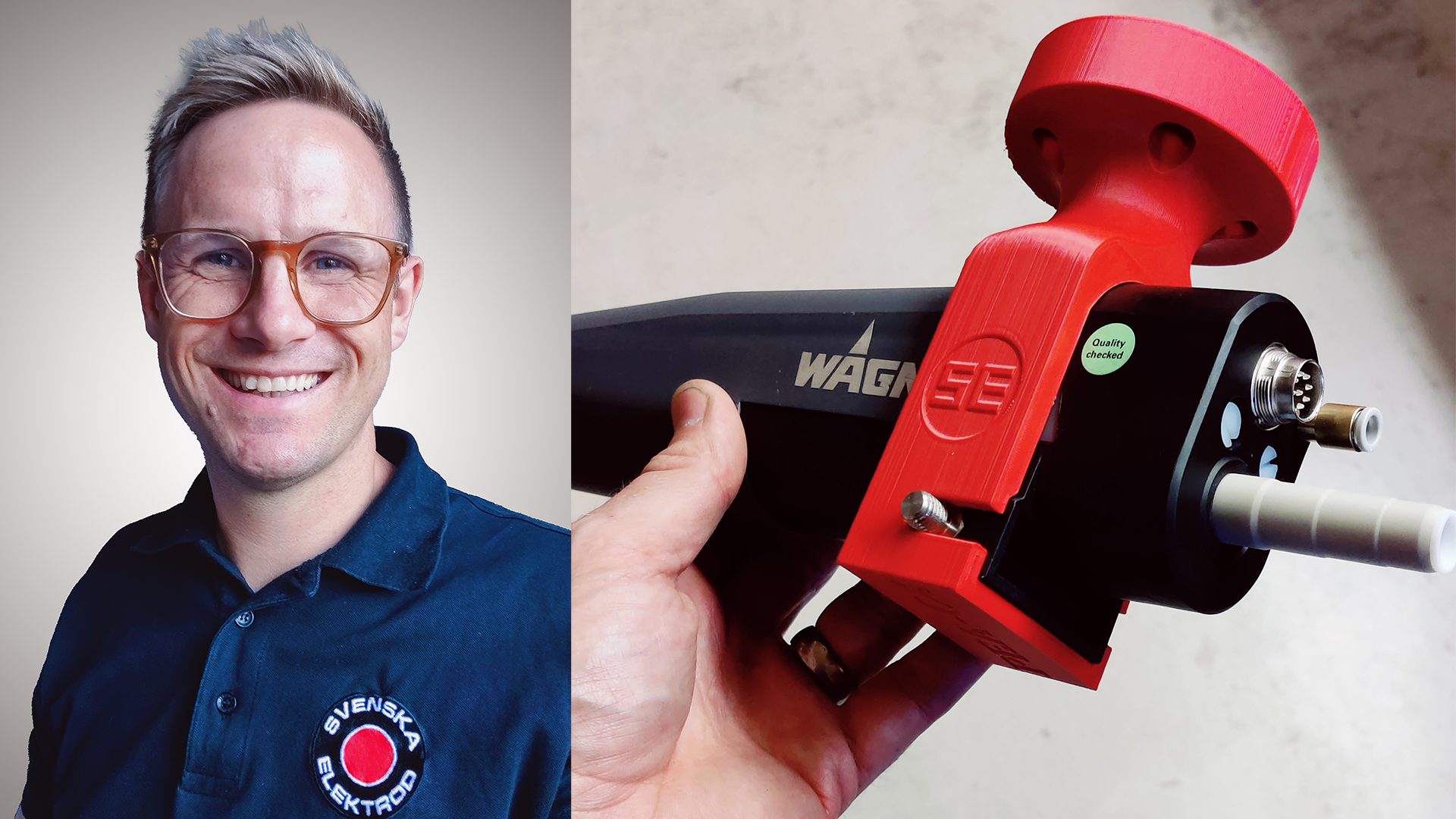
Many manufacturing companies struggle with low levels of automation and outdated machinery. This makes it difficult to work more efficiently. Here, 3d-printing for industrial robots is a solution. The technology allows you to produce precisely tailored robot tools for your automation more cheaply and quickly.
We spoke with Karl Ericsson, CTO at SE Automation, about how the company uses small means, smart processes and its own 3D printers to create valuable customizations for its customers.
Challenges in today's robotics: Mentality gap and old working methods
For those looking to start using industrial robots for automation, traditional manufacturing methods are still a bottleneck. Robot installations were time-consuming, expensive, and largely manual. It was also difficult to create the customizations customers needed for their production lines. But according to Karl Ericsson, CTO at SE Automation, many of these obstacles are soon to be overcome, thanks in large part to 3D printing.
“Just take the supply chain in robotics. It has improved significantly with the introduction of 3D printing and 3D design,” says Karl. “Basically, we can get a customer request, cadde up an idea and send it to our 3D printer for delivery the next day. That wasn’t the case in our industry just a few years ago.”
Despite the technological leap, there is still a significant challenge to be tackled – a knowledge gap between integrators like SE Automation and manufacturing companies that still think of automation as a large, long-term investment.
“The big obstacle in robot integration is what you might call the ‘delivery chain.’ Many of our customers are stuck in an old mindset where installing robot cells was a big and mostly manual job. That’s not the case anymore,” says Karl.
3D printing for industrial robots is crucial for integrators
More and more robot integrators today see 3D printing as a must-have in their operations. The technology makes it possible to quickly and efficiently create customized components. This reduces costs and lead times while increasing customer satisfaction. Karl Ericsson at SE Automation explains that it is difficult to imagine modern robot integration today without 3D printing.
"3D printing has become a commodity, easy to use and adds great value. I find it very difficult to see a robot integrator doing without 3D printing today," says Karl.
By using 3D printing for industrial robots, SE Automation can not only create customized solutions for its customers, but also adapt faster when needs change.
And once a company starts using the technology, they tend to come back for more projects.
"Once we sell our concept of 3D-printed robotic tools, it becomes redeeming. This is also where we have a high percentage of repeat business, because these customers have really realized the benefits of a more modern way of thinking," says Karl.
From prototype to finished product with 3D printing
One of the clearest advantages of 3D printing is how quickly you can go from idea to finished product. In traditional manufacturing, it can take weeks or months to create custom tools or parts. If you choose to 3D print your parts, you can have them delivered in days or hours.
“The technology has the biggest impact right from the start, in the prototype stage. But we are seeing increasing value even with end products. For example, we have manufactured many smaller functional parts as prototypes, but which end up with a finished product,” says Karl.
This trend means that integrators like SE Automation can not only deliver faster, but also give their customers greater flexibility to iterate and improve their solutions over time and as they gain more experience - without stopping production.
Adaptation and flexibility are the key to automation
Adaptability is crucial in today's robotics industry, and 3D printing for industrial robots is a key factor here. Customizing tools and components gives integrators and manufacturing companies a competitive advantage. And constant iterations of the tools and components allow you to streamline faster and more often.
“Customization of parts is really important,” says Karl. “And customizations can be made faster and faster, down to a few hours of print time. Plus, we can recycle an increasing proportion of the materials we use. This not only makes the process faster, but also more sustainable.”
Collaborative robots and 3D printing an unbeatable combo
In the field of collaborative robots, or cobots, 3D printing has proven to be an unbeatable solution. Collaborative robots work side by side with humans and often require custom-made tools and grippers to function effectively.
“In collaborative robots, 3D printing is here to stay. The need for 3D printed tools and aids is much greater here than for larger, industrial solutions that lift several hundred kilograms, for example,” says Karl. “This ability to quickly create customized tools makes 3D printing an indispensable component in cobots and their applications.”
3D printing has become an industry standard
In robotics, 3D printing has gone from being a visionary technology to an industry standard. For companies like SE Automation, this means they can demonstrate working concepts to potential customers in a shorter time.
“Going from an idea to a fully conceptualized cell that is fit-for-purpose – that chain is moving much faster today,” explains Karl. “This speed and flexibility has given integrators a strong competitive advantage, and for companies that want to remain competitive, 3D printing is a must.”nth concept in a shorter time to potential customers.
Education and knowledge exchange accelerate 3D printing adoption
Despite all the benefits of 3D printing for industrial robots, there are still obstacles to overcome. The biggest challenge, according to Karl, is the lack of knowledge in the industry. Many companies simply don't understand how to take advantage of the technology.
“There simply aren’t enough people in Sweden who really know how to 3D print. It’s a new process that requires a new mindset,” explains Karl. “But there are also opportunities. Through internet communities and knowledge sharing, more companies have the opportunity to quickly learn and benefit from the technology.”
3D printing helps manufacturing companies grow
For companies considering investing in a robotic solution, 3D printing for industrial robots offers significant benefits. It enables faster lead times, lower costs, and customized solutions that were previously difficult to achieve with traditional methods.
“3D printing is truly the key to success as an integrator,” says Karl Ericsson. “By using the technology, companies like SE Automation can deliver flexible and efficient solutions that help manufacturing companies grow and remain competitive.”


