

Additive manufacturing is transforming modern production
Additive manufacturing, also known as 3D printing, builds products layer by layer from a digital CAD model. Unlike traditional methods, where materials are milled or cut away, additive manufacturing adds material only where it is needed. The result is complex geometries and customised components without costly moulding tools.
The technology is used in everything from industrial serial production and spare parts supply to advanced medical technology and aeronautics.

High material strength

Versatile

Rapid prototyping

Chemical resistance
Additive manufacturing technician
Additive manufacturing encompasses several technologies, each adapted to specific materials and requirements. The choice of technology affects everything from surface finish and mechanical properties to production speed and cost per part.
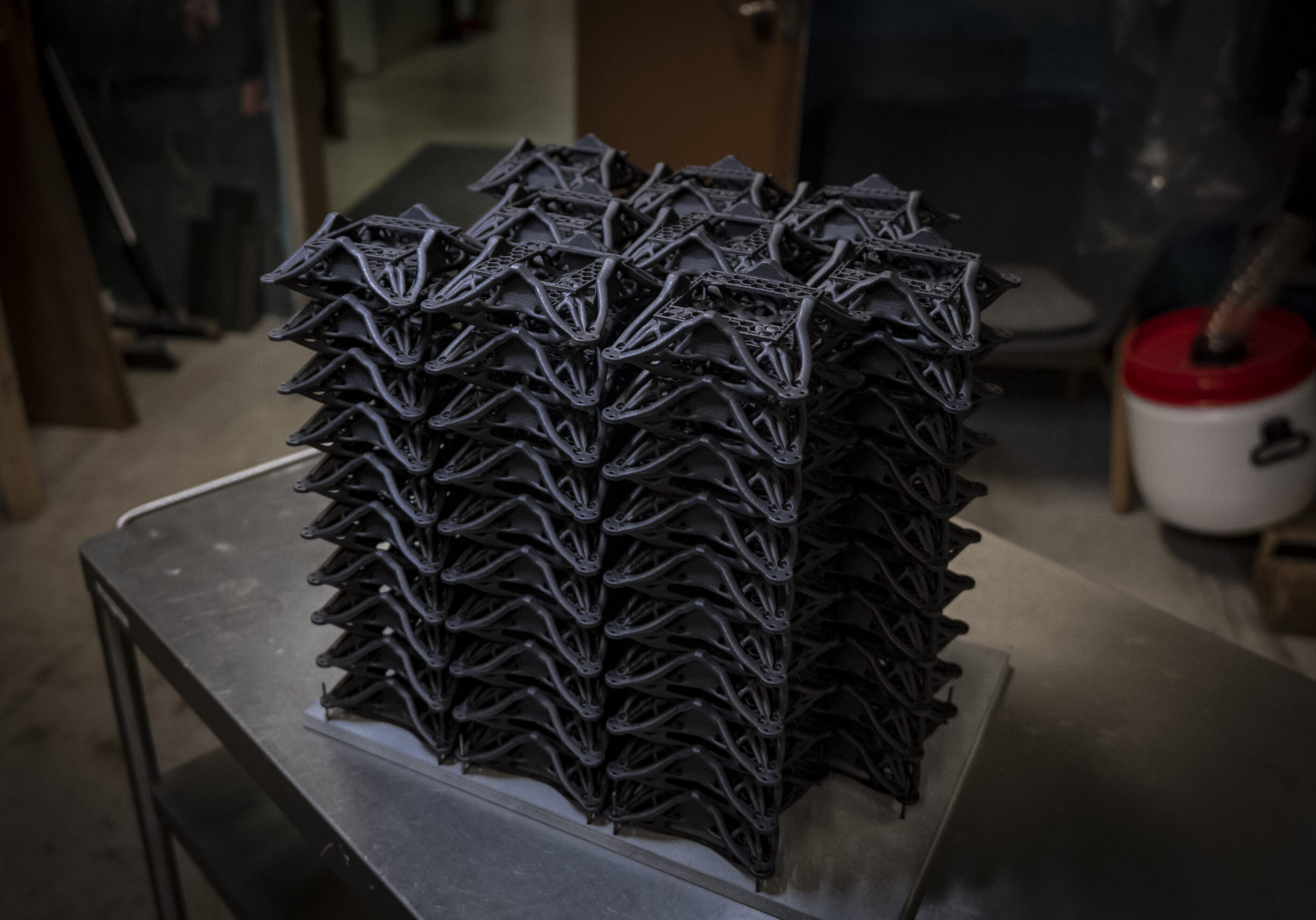
Powder bed methods are at the heart of industrial additive manufacturing. HP Multi Jet Fusion (MJF) uses liquid binders and infrared heat to fuse powder particles together. The technology provides high detail, good mechanical properties and the possibility of efficient series production. Selective laser sintering (SLS) works in a similar way but uses a laser to sinter the powder, which is suitable for functional plastic parts.
For metal components we use DMLS (Direct Metal Laser Sintering), a powder bed technology where a laser selectively melts metal powder into dense, strong parts. It is the same basic principle as SLM (selective laser melting) and is suitable for demanding applications in stainless steel, aluminium and titanium.
In addition to powder bed methods, we offer FDM (Fused Deposition Modelling), which builds parts by extruding thermoplastics layer by layer, and STEP technology, a newer method that combines high surface finish with ABS plastic. Photopolymerisation methods such as SLA and DLP allow for extremely high precision, but result in more brittle materials.
Our primary technology is HP's Multi Jet Fusion. MJF delivers parts with near-isotropic properties (equivalent in X, Y and Z), making it particularly suitable for functional end products and not just prototypes.
Materials in additive manufacturing
The choice of material determines the strength, chemical resistance, temperature resistance and surface finish of the finished product. In additive manufacturing, there is a growing range of both plastic and metal materials.
In plastics, we work mainly with PA12 (nylon), PA12 is an age-resistant material with good chemical and UV resistance. PA12 is suitable for everything from machine components to consumer products. For applications that require higher stiffness, we offer PA12 GB (glass filled), and for impact-resistant parts there are ABS via STEP technology.
Within metal 3D printing we offer stainless steel (316L) for corrosive environments, aluminium for lightweight applications and titan for biomedical and high-performance applications.
Advantages of additive manufacturing
The method offers several tangible advantages over conventional manufacturing methods such as injection moulding, CNC machining and casting.
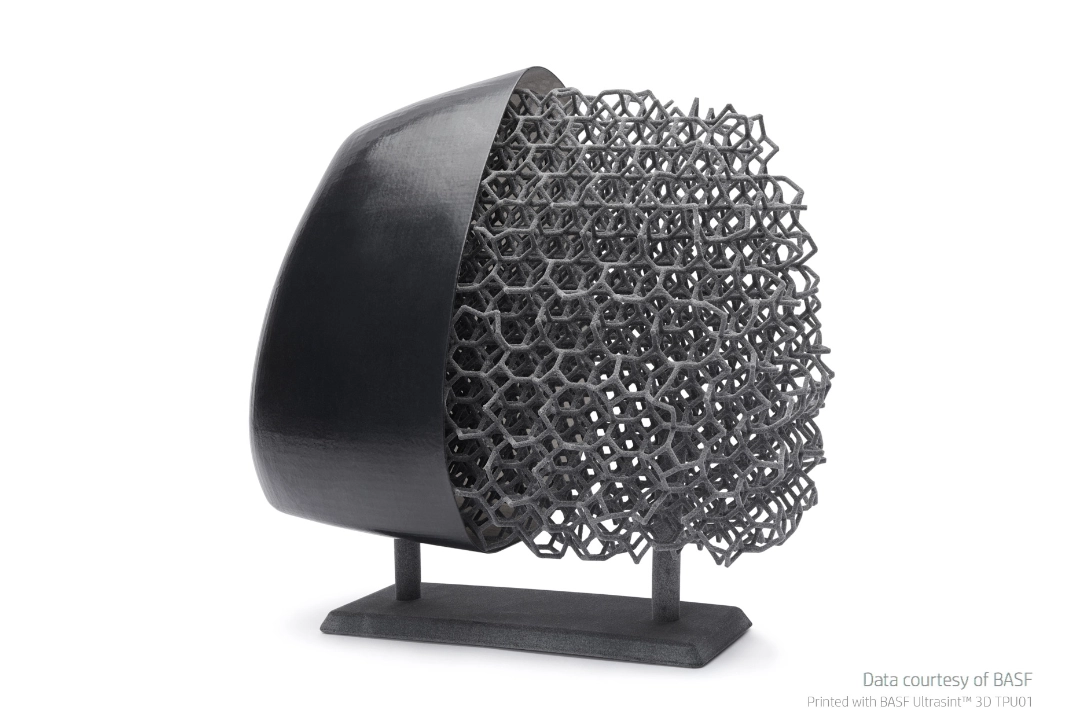
Design freedom without moulds. Complex geometries, internal channels and organic shapes that are impossible to produce by milling or injection moulding can be produced directly from a CAD file. No expensive moulds or fixtures are needed, eliminating start-up costs for new products.
Shorter lead times. From approved CAD file to finished part, the process often takes just 3-7 working days. This makes the technology ideal for rapid prototyping, but also for urgent spare parts and production runs.
Material efficiency and sustainability. Because material is only added where it is needed, waste is greatly reduced. In our MJF production, around 80 % of unused powder is recycled directly into the next run, reducing both costs and environmental impact.
Consolidation of components. Parts that traditionally consist of several assembled parts can often be joined into a single component. This reduces assembly time, the risk of failure points and the stocking of separate items.
Flexible scaling. The same production line handles everything from a single prototype to series of hundreds or thousands of parts, with no changeover costs.

Additive manufacturing compared to traditional methods
It does not replace all conventional manufacturing methods, but it fulfils an important role where traditional techniques become costly or limiting. Injection moulding is still superior at very high volumes (tens of thousands of parts), but requires expensive moulds and long start-up times. CNC machining provides excellent precision but involves high material waste for complex geometries.
Additive manufacturing is best suited to complex shapes that cannot be milled, short to medium runs (typically 1-5,000 parts depending on size), urgent needs with short lead times, product development and iteration where the design may change between runs, and consolidation of multi-component assemblies.
A good rule of thumb: if your part is geometrically complex, needed in moderate volume and the design is not 100 % locked in, the method usually pays off from the first part.
Additive manufacturing in industry
Additive manufacturing is now used in a wide range of industries, and applications are growing as materials and technologies mature.
Within automotive industry technology streamlines development processes through rapid prototyping. Fixtures, assembly tools and special parts can be produced on demand instead of being kept in stock. Several Swedish automotive suppliers are already using the technology in their production flows.
Machine builders and automation companies benefit from the ability to produce customised grippers, cable holders and sensor housings without long lead times from subcontractors. robot integration technology enables lightweight components that improve the range and speed of robots.
Drone development is an area where the method has gone from prototype to final product. The ability to produce lightweight structures with internal stiffeners makes 3D printing a natural fit for flying vehicles.
The aerospace, medical technology and energy sectors have also integrated the technology into their processes. Within AM Printservice, we collaborate with the IMA research institute at Linköping University, where we help develop methods for qualifying additively manufactured components in demanding applications.


How AM Printservice works with additive manufacturing
AM Printservice is a Swedish service agency specialising in industrial additive manufacturing in plastic and metal. We offer the entire chain, from advice and design optimisation to production and delivery.
Our core expertise lies in HP Multi Jet Fusion, where we have the capacity to handle everything from single prototypes to ongoing production series with call-off deliveries. As a partner in the On Demand 2033 network, we also have access to extended capacity in SLS, DMLS and FDM.
Ordering is easy via our digital ordering tools, where you upload your CAD file and get a quote directly. If you need advice on material selection, design customisation for additive manufacturing (DfAM) or series production set-up, you are welcome to contact us for a free consultation.
Frequently asked questions about additive manufacturing
Contact us
Additive manufacturing is developing rapidly. Research into new materials, hybrid technologies and multi-colour printing is opening up even more applications. Automation and digitalisation are creating more efficient production flows, making the technology even more attractive for wider industrial use.
At AM Printservice, we help companies benefit from additive manufacturing through customised 3D printing solutions of metal and plastic.. Whether you need customised components or mass-produced parts, we can guide you through the process. Contact us for a consultation and discover how we can optimise your production.


