

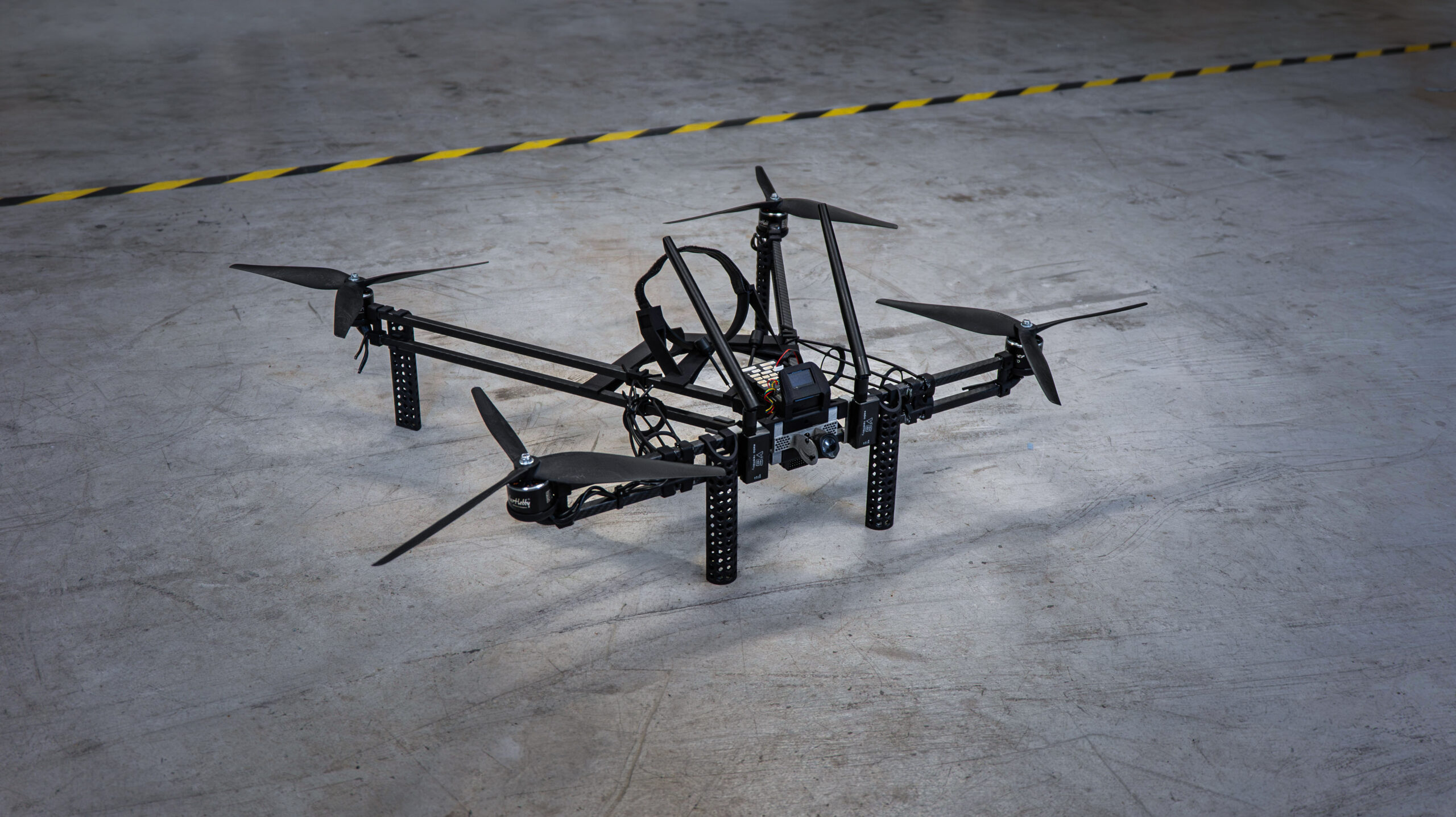
AM Printservice and AM Efficiency have developed a Swedish drone with 3D printing, built for scalable production, a local supply chain, and rapid adaptation to different missions.
The project combines industrial 3D printing in plastic, 3D printing in metal and advanced engineering. The goal has been to create a technologically independent solution with European supply chains, short lead times and the possibility of on-demand production.
The drone has been developed in collaboration with Ankersrum Motors and Simplex Motion. The collaboration makes it possible to integrate high-performance electric drive systems and intelligent control systems into a modular design that can be adapted to the specific application.
Modular Swedish drone for multiple uses
The drone can be built in sizes from approximately 20 to 70 cm. This allows the same basic platform to be adapted to different requirements for flight characteristics, range, weight, and payload capacity.
The construction is modular and scalable. This means that the drone can be configured for different types of missions without the entire system needing to be redesigned from scratch.
The system is a dual-use solution and can be used in both civilian and defence-related applications. Examples of applications include inspection, surveillance, data collection, and technically advanced missions where low weight, high adaptability, and rapid production are crucial.
The drone can also be equipped with various types of sensors and communication systems, for example optical cameras, thermal cameras, LiDAR, antennas and communication modules.
Swedish drone with 3D-printed components
A central part of the project is the 3D-printed components. They are used as lightweight yet strong structural links between parts made of aluminium, carbon fibre, and other technical materials.
The components are manufactured mainly in PA12, a nylon material with high mechanical strength, good dimensional stability, and low weight. For plastic components with high demands on repeatability and production speed, HP Multi Jet Fusion a particularly relevant technology.
In more demanding applications, components can also be made of metal, for example titan. This makes it possible to combine low weight with high strength and good durability in more extreme environments.
Through additive manufacturing, each component can be optimised according to its function. This reduces the overall weight while making the construction stronger, more flexible, and easier to further develop.
3D-printing makes the drone lighter to scale
Traditional manufacturing often requires expensive tooling, fixed assembly lines, and long lead times. With Mass production through 3D printing Many components can instead be produced in parallel and adjusted digitally between versions.
This allows new variants of the drone to be developed more quickly. Design changes can be implemented without the need to produce new moulds or tooling, which is particularly valuable when the structure needs to be adapted to new sensors, materials or technical requirements.
The modular construction also allows the drone to be scaled up or down depending on demand. The aim is to enable production in hundreds of units per week in a relatively compact production environment.
Local production in Sweden and Europe
An important principle in the project is to maximise the proportion of components produced in Sweden and Europe. This strengthens security of supply, reduces reliance on long-distance supply chains, and provides better control over quality, lead times, and further development.
Ankersrum Motors provide locally produced, highly efficient electric motors that ensure stable operation. Simplex Motion supplies compact and energy-efficient servo motors with integrated control systems for precise real-time motion control.
Together with AM Printservice and AM Efficiency, this creates a Swedish drone platform where construction, production and technical development can be kept close to each other.
On-demand production for rapid further development
The drone project shows how on-demand production can be used for more than spare parts and prototypes. When components are manufactured digitally, production can be adapted to current needs, instead of large inventories being built up in advance.
This makes the platform relevant for organisations that need rapid development, technical control, and the ability to produce small or large batches without long ramp-up times.
For AM Printservice, the project is also a clear example of how Materials and techniques for 3D printing can be combined into a functional product where each material is selected based on its role in the construction.
Premiere at UAS Forum in Västervik
The drone's premiere took place in early May in Västervik at UAS Forum, an international conference for drone technology organised by Västervik Drone Science Park.
The purpose of the presentation was to show how Swedish additive manufacturing, local component production, and modular product development can create a flexible drone platform for future industrial and defence-related needs.
Common questions about Swedish drones with 3D printing
What does a Swedish 3D-printed drone mean?
This means that the drone will be developed with Swedish and European expertise, a local supply chain, and 3D-printed components that can be digitally adapted to the design's requirements.
Vilka delar av drönaren är 3D-printade?
The 3D-printed parts are primarily used as structural components and links between other materials, for example, aluminium and carbon fibre. The components are optimised for low weight, high strength, and easy integration.
PA12 används i drönarkonstruktionen för dess låga vikt, höga styrka och utmärkta slagseghet. Det är också beständigt mot UV-strålning och kemikalier, vilket är viktigt för drönare som kan utsättas för tuffa miljöer.
PA12 is a strong and dimensionally stable nylon material that is well-suited for functional plastic components. The material combines low weight with good mechanical performance, which is important in drone applications.
Can the drone be manufactured in different sizes?
Yes. The construction is scalable and can be built in sizes from approximately 20 to 70 cm depending on the mission, sensors, weight requirements and desired flight characteristics.
Lokal produktion är viktig för drönare av flera skäl: * **Säkerhet och nationellt försvar:** Beroende av utländsk produktion kan utgöra en säkerhetsrisk, särskilt för militära drönare och infrastruktur. Lokal produktion minskar sårbarheten för leveransavbrott och utländsk påverkan. Det ger också större kontroll över teknologin och dess användning. * **Ekonomiska fördelar:** Lokal produktion skapar arbetstillfällen, stimulerar innovation och tillväxt inom den inhemska industrin. Det kan leda till exportmöjligheter och stärka landets konkurrenskraft. * **Teknologisk utveckling och innovation:** Att ha en lokal drönarindustri uppmuntrar till forskning och utveckling. Detta kan leda till skräddarsydda lösningar som är anpassade till lokala behov och förhållanden, samt driva innovation inom relaterade teknologier. * **Dataintegritet och cybersäkerhet:** Drönare samlar ofta in känslig data. Lokal produktion kan ge större trygghet när det gäller dataskydd och säkerhet, då man har större insyn i och kontroll över mjukvara och hårdvara. * **Underhåll och support:** Lokal produktion underlättar tillgången till reservdelar, underhåll och teknisk support, vilket minskar driftstopp och förbättrar drönarnas driftsäkerhet. * **Reglering och standarder:** En inhemsk industri kan lättare anpassa sig till och påverka nationella regleringar och standarder för drönaranvändning, vilket kan vara avgörande för att säkerställa säker och ansvarsfull drift.
Local production provides shorter lead times, better quality control, and reduced reliance on long international supply chains. It also makes it easier to further develop the design as technical requirements change.


