

What is TPU?
The plastic we use to manufacture flexible 3D parts in HP Multi Jet Fusion is TPU (thermoplastic polyurethane). With this guide, we aim to provide a clear overview of its properties, technical data, and applications.
TPU is an elastomeric material with a segmented molecular structure comprising hard and soft segments, which provides a unique combination of flexibility, abrasion resistance, and mechanical stability. The material is characterised by high elongation, good rebound after deformation, and very good resistance to wear, impact, and dynamic loads. Thanks to this, TPU is used in applications where both flexibility and functional strength are required.
Ultrasint® TPU01 – Technical Properties
Ultrasint® TPU01 is a TPU powder developed for HP Multi Jet Fusion and optimised for the production of flexible and functional components.
The material has a bulk density of 0.5 g/cm³ and a density for printed parts of approximately 1.1 g/cm³. The average particle size is in the range of 70–90 µm, which contributes to good flowability and stable processability in industrial production. The glass transition temperature is approximately -48 °C, providing good flexibility even at low temperatures, while the melting range is between 120 and 150 °C.
From a thermal point of view, the material exhibits UL 94 HB classification (1.6–4.2 mm) and a Vicat softening temperature of approximately 97–98 °C, providing stability under normal operating conditions.
Mechanical properties
TPU01 has a Shore A hardness of 88–90 and exhibits a tensile strength of approximately 9 MPa in the X-direction and 7 MPa in the Z-direction in accordance with DIN 53504. The elongation at break is very high, amounting to approximately 280 % in the X-direction and 150 % in the Z-direction, which clearly demonstrates the material’s elastic nature.
The modulus of elasticity is around 85 MPa and the flexural modulus is approximately 75 MPa, providing a good balance between flexibility and dimensional stability. The tear strength is also high, with approximately 21 kN/m in the X-direction and 18 kN/m in the Z-direction for propagation, and up to 38 kN/m and 32 kN/m respectively for initiation.
The material exhibits a compression set of approximately 23–24 % after 72 hours at 23 °C, as well as a rebound of approximately 63 %, which is important for applications involving repeated deformation.
Abrasion resistance is around 96–100 mm³ according to DIN ISO 4649. In impact testing, the material exhibits very good performance without fracture at room temperature, and 44–46 kJ/m² at -10 °C. In fatigue testing (Rossflex, 100,000 cycles), no crack growth is observed, confirming the material's high dynamic durability.
Biological and chemical properties
Ultrasint® TPU01 has been tested according to relevant standards for skin contact and meets requirements for cytotoxicity (ISO 10993-5), in vitro skin irritation (OECD 439), and in vivo sensitisation (ISO 10993-10 / OECD 429), with all tests showing a satisfactory result.
The material also has good resistance to UV radiation and hydrolysis, making it suitable for both indoor and outdoor applications.
Typical uses
TPU01 is used in a wide range of applications where flexibility, abrasion resistance and durability are crucial. This includes sports and leisure products where shock absorption is required, footwear and comfort components, as well as the transport industry where vibrations and mechanical stresses occur.
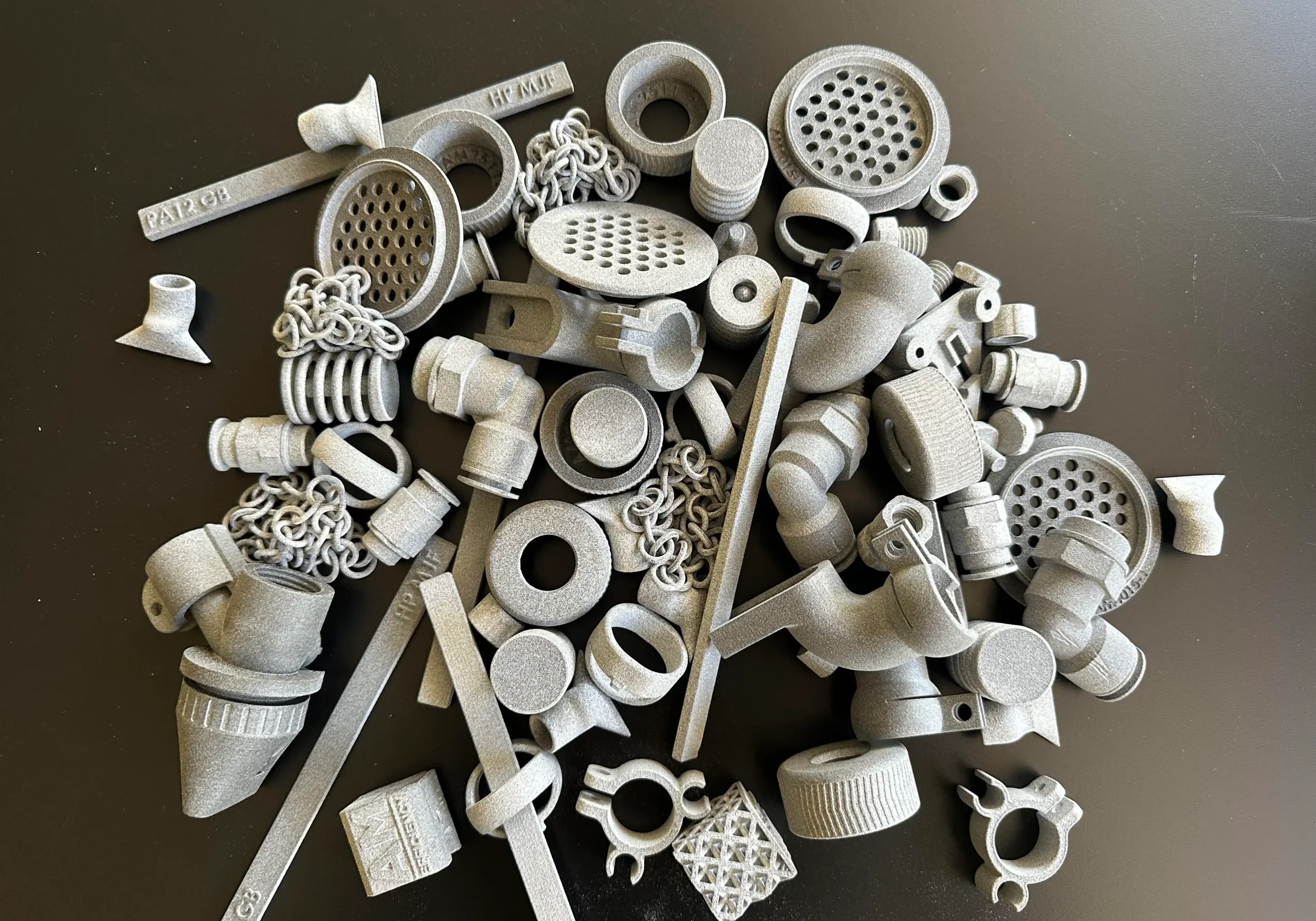
The material is also suitable for the manufacture of various types of rubber-like components, such as flexible guards, seals, protective hoses, bushings, and moving parts that require repeated deformation and return to their original shape. TPU is also used in jigs and fixtures where soft, non-slip grip surfaces or protective components are needed.
Materials are also used in functional prototypes where real operating conditions for elastic components are tested, such as hinges, shock absorbers, technical guards and other dynamically working parts.
Contact us
Do you want to know more about 3D printing in TPU?
We help you evaluate whether 3D printing with TPU is the right solution for your project. Whether you are developing a new product, need functional prototypes, or are manufacturing technical components in small volumes, our technology offers an efficient alternative to traditional production.
Please contact us to discuss your needs – we would be happy to tell you more about how our 3D printing in thermoplastics can help shorten development time and increase product value.


